AI call centre software is rapidly reshaping how businesses handle customer conversations. Instead of long wait times, repetitive questions, and overwhelmed agents, modern contact center solutions are leveraging next-generation AI for call center automation to deliver faster, more personalised, and more efficient support around the clock.
This guide walks you through what AI call centre software is, how it works, the core features to look for, and how it can help you boost customer satisfaction while reducing operating costs.
Why Businesses Are Adopting AI Call Centre Software
Businesses today are under pressure to deliver instant, accurate, and personalized customer service. Traditional call center setups struggle to keep up with rising demand, leading many organizations to explore advanced computing solutions for customer support. These solutions combine high-speed processing with AI-driven decision-making to handle repetitive queries and free up agents for complex cases.
For companies that manage vast amounts of customer data, supercomputing resources for modern call centers are increasingly essential. Leveraging these platforms allows call centers to analyze trends, predict customer needs, and automate routine workflows more efficiently than ever before.
Meanwhile, marketing teams are learning how to integrate AI-driven insights from call center software into broader campaigns. By aligning customer service data with marketing strategies, businesses can improve engagement and conversion rates, which is highlighted in resources like Marketing for Customers - How marketing can boost customer satisfaction
Many companies also explore how marketing runners can optimize AI support systems to ensure seamless communication across multiple channels. This integration not only enhances the customer experience but also provides agents with actionable insights for faster problem resolution.
Finally, organizations aiming for better financial oversight can turn to top financial resources for AI-driven contact centers to measure ROI, reduce operational costs, and forecast budgets more accurately. Combining financial intelligence with AI call centre software ensures both customer satisfaction and business efficiency.
Top 10 AI Call Centre Software Solutions for Modern Contact Centers
When it comes to AI call centre software, selecting the right solution can dramatically improve customer experience, reduce operational costs, and streamline agent workflows. Here’s a list of the top 10 providers, starting with the leading platform, Bright Pattern.
1. Bright Pattern – Leading AI Contact Center Solutions
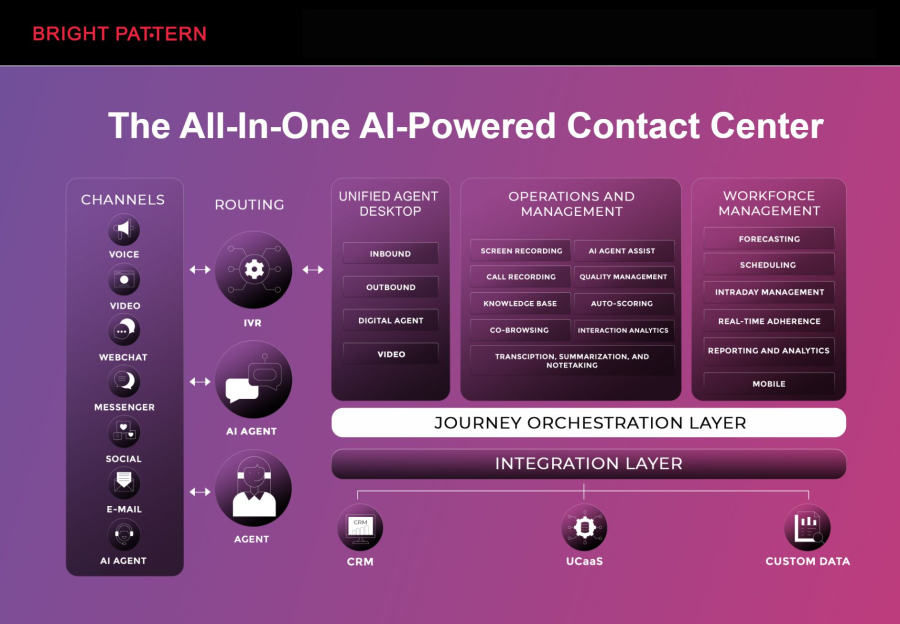
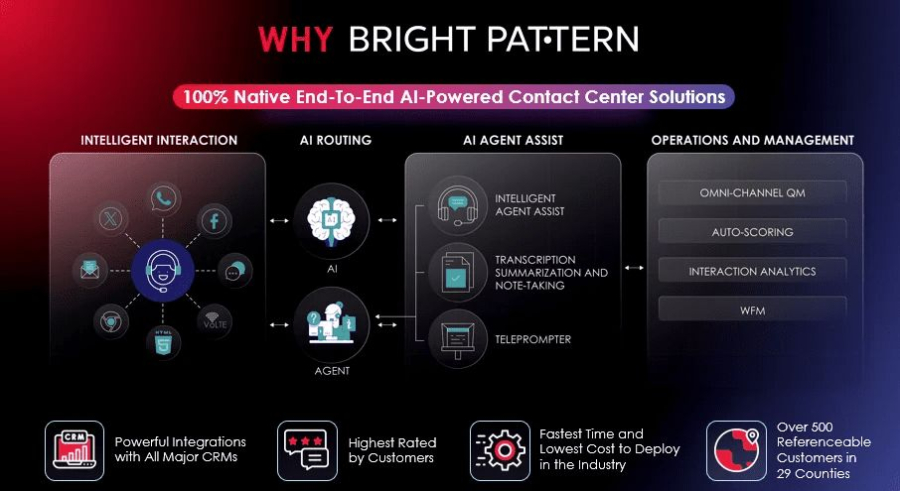
Bright Pattern is recognized as a top provider of AI call centre software, delivering advanced capabilities for omnichannel communication and intelligent automation. It helps businesses manage customer interactions across voice, chat, email, social media, and messaging apps with a single unified platform.
Key features of Bright Pattern include:
- AI-powered routing to ensure customers reach the right agent quickly
- Virtual agents for automated support and handling routine inquiries
- Omnichannel contact center solutions for seamless communication
- Real-time analytics to monitor performance and improve service quality
- Integration with CRM systems and business applications for better workflow
Bright Pattern’s AI capabilities allow contact centers to automate repetitive tasks, enhance agent productivity, and provide faster, more personalized responses to customers, making it a top choice for companies aiming to modernize their support operations.
2. Genesys Cloud
Genesys Cloud provides AI-driven contact center solutions with intelligent routing, workforce optimization, and self-service capabilities. It is designed to scale with growing customer service needs while enhancing agent performance.
3. Five9 Intelligent Cloud Contact Center
Five9 offers AI call centre software with predictive dialing, automation tools, and omnichannel engagement, allowing businesses to streamline operations and improve customer satisfaction.
4. NICE inContact CXone
NICE inContact CXone combines AI analytics, automated interactions, and workforce management to create seamless customer experiences across multiple channels.
5. Talkdesk CX Cloud
Talkdesk CX Cloud uses AI-powered automation, advanced analytics, and workflow integration to deliver efficient contact center solutions for businesses of all sizes.
6. Avaya OneCloud CCaaS
Avaya OneCloud CCaaS offers AI-enhanced features, including intelligent routing, virtual agents, and actionable insights, enabling more responsive and efficient customer support.
7. RingCentral Contact Center
RingCentral integrates AI tools into its contact center software, providing features like automated workflows, real-time analytics, and omnichannel engagement for improved customer interactions.
8. 8x8 Contact Center
8x8 combines AI and cloud-based technology to deliver multichannel contact center solutions, helping companies reduce costs while boosting customer satisfaction.
9. Zendesk Suite
Zendesk uses AI to enhance support workflows, automate routine tasks, and provide insights for agents, enabling a more efficient and responsive contact center environment.
10. Freshworks Contact Center
Freshworks provides AI-driven call center solutions with automation, predictive analytics, and omnichannel capabilities, ensuring faster resolution times and improved customer engagement.
What Is AI Call Centre Software?
AI call centre softwareis a set of tools that use artificial intelligence to automate, assist, and improve customer interactions over voice and digital channels. It can answer routine questions, route calls intelligently, coach agents in real time, and analyse conversations at scale.
Unlike traditional call centre systems that rely heavily on manual processes, AI powered platforms can understand natural language, detect intent, and respond or assist accordingly. The goal is not to replace human agents entirely, but to make every interaction faster, more accurate, and more convenient for both customers and staff.
Key Capabilities of AI in a Call Centre
- Automationof repetitive, low value conversations and tasks.
- Augmentationof human agents with real time suggestions and guidance.
- Analyticsthat turn thousands of calls into actionable insights.
- Personalisationusing customer history and context across channels.
How AI Call Centre Software Works
Although individual platforms differ, most AI call centre solutions share a set of underlying technologies that power their capabilities.
Core Technologies Behind AI Call Centres
- Automatic Speech Recognition (ASR)converts spoken words into text in real time, allowing the system to "listen" to calls.
- Natural Language Processing (NLP)interprets what customers mean, not just what they say, by identifying intent, entities, and sentiment.
- Natural Language Understanding (NLU)goes deeper into context, allowing AI to handle more complex queries and multi turn conversations.
- Natural Language Generation (NLG)helps the system generate human like responses, whether via text bots or AI voice assistants.
- Machine Learning (ML)continuously improves predictions, routing, and recommendations based on real interaction data.
- Text to Speech (TTS)converts AI generated responses into natural sounding voice for phone calls.
Where AI Fits in the Call Flow
AI can be embedded at multiple touchpoints in your existing call flow:
- Before a call: Predict call volume, staff schedules, and likely topics based on historical data.
- At the start of a call: Virtual agents greet customers, authenticate them, and either resolve the issue or route them appropriately.
- During the call: AI listens in, surfaces knowledge base articles, suggests next best actions, and monitors compliance.
- After the call: AI generates call summaries, tags reasons for contact, and updates CRM records automatically.
Benefits of AI Call Centre Software
When designed and implemented well, AI delivers value to every stakeholder in the contact centre ecosystem: customers, agents, supervisors, and the business as a whole.
For Customers
- Shorter wait times: Virtual agents and intelligent routing reduce queue times by handling simple requests instantly and directing complex ones to the right specialist.
- 24/7 availability: AI powered self service operates around the clock, even when human teams are offline.
- More consistent answers: AI draws from a central knowledge base, reducing the risk of conflicting or outdated information.
- Personalised interactions: Systems can recognise returning customers, recall previous interactions, and adapt responses accordingly.
For Agents
- Less repetitive work: Routine FAQs and simple transactions are handled by AI, freeing agents for higher value conversations.
- Real time coaching: On screen prompts suggest answers, highlight next steps, and remind agents of key compliance phrases.
- Reduced manual admin: Automatic call summaries and logging mean less time spent on post call wrap up.
- Higher job satisfaction: Agents spend more time solving meaningful problems and less time copying data or repeating the same answers.
For Supervisors and Leaders
- Deeper visibility: AI driven analytics reveal trends in customer issues, sentiment, and agent performance across all interactions.
- Improved quality management: Instead of sampling a small percentage of calls, leaders can analyse every interaction for quality and compliance.
- Smarter workforce planning: Accurate forecasts of call volume and topic mix support better staffing decisions.
- Lower cost per contact: Automation and efficiency gains directly reduce operating costs while improving outcomes.
Why AI Outperforms Traditional IVR
Many organisations already use interactive voice response ( IVR ) systems to route calls, but these often rely on rigid menus and keypad inputs. AI call centre software offers a more natural, conversational experience. Customers can simply explain their issue in their own words, and the system interprets their intent instead of forcing them through step by step menus.
Essential Features to Look For in AI Call Centre Software
Not all platforms offer the same functionality. When evaluating AI call centre software, it helps to understand the key features that drive real value.
1. AI Powered Virtual Agents and Voicebots
Virtual agents can answer calls, authenticate customers, and complete common tasks without human intervention. Look for:
- Natural language supportso customers can speak conversationally instead of using strict commands.
- Multi language capabilitiesif you serve international or multilingual audiences.
- Integrationwith your CRM, ticketing, and order management systems to complete transactions, not just provide information.
2. Intelligent Routing and Triage
AI can analyse the caller's language, intent, and profile to route them to the most suitable agent or workflow.
- Skill based routingthat pairs customers with agents who have the right expertise.
- Priority routingfor high value customers or urgent issues.
- Channel blendingto move conversations smoothly between voice, chat, and email when appropriate.
3. Real Time Agent Assist
During live calls, AI can act as a "co pilot" for human agents.
- Live transcriptionof the conversation for quick reference.
- Contextual suggestionsof answers, knowledge articles, and next best actions.
- Compliance monitoringthat flags missing disclosures or risky language in real time.
4. Post Call Automation
After each interaction, AI can streamline wrap up and reporting.
- Automatic summarisationthat turns long conversations into concise, structured call notes.
- Disposition predictionto pre fill reason codes based on the conversation.
- Workflow triggersthat open follow up tasks, cases, or orders automatically.
5. Conversation Analytics and Insights
One of the most powerful benefits of AI call centre software is the ability to analyse every conversation, not just a small sample.
- Topic detectionto see why customers are contacting you and how issues evolve over time.
- Sentiment analysisto monitor customer emotion and satisfaction across channels.
- Trend identificationthat surfaces recurring problems, product feedback, or process breakdowns.
6. Omnichannel Support
Although the focus is on calls, many AI platforms also support chat, messaging, and email. Unified AI across channels ensures consistent experiences and centralised reporting.
High Impact Use Cases for AI Call Centre Software
To understand the real world impact, it is useful to look at specific use cases that consistently deliver strong results.
1. Handling Routine Service Requests
Tasks like password resets, order status checks, balance inquiries, and appointment changes are ideal for automation. AI can authenticate the customer, access the relevant system, and process the request without human involvement.
2. First Line Technical Support
AI can guide customers through basic troubleshooting steps, run simple diagnostics, and collect key information before handing off to a specialist if needed. This reduces handle time and increases first contact resolution.
3. Proactive Outbound Notifications
AI driven outbound calls and messages can notify customers about upcoming appointments, payment reminders, service interruptions, or delivery updates. Automating these touchpoints reduces inbound call volume and improves transparency.
4. Sales and Cross Sell Support
During inbound or outbound sales calls, AI can suggest relevant offers based on customer profile, behaviour, and conversation cues. Agents receive prompts in real time, helping them tailor recommendations and increase conversion rates.
5. Quality Assurance and Compliance
Instead of manually listening to a small fraction of calls, AI can scan every interaction for compliance keywords, script adherence, and risk signals. Supervisors can then focus coaching time where it makes the biggest difference.
Key Metrics to Track with AI Call Centre Software
To prove the value of AI investments, it is important to track clear metrics before and after implementation.
|
Metric |
How AI Helps |
|
Average Handle Time ( AHT ) |
Shortens calls via automation, better routing, and real time guidance. |
|
First Contact Resolution ( FCR ) |
Improves agent accuracy and access to information on first contact. |
|
Customer Satisfaction ( CSAT ) |
Boosts speed, convenience, and consistency of responses. |
|
Net Promoter Score ( NPS ) |
Enhances overall customer experience through smoother journeys. |
|
Containment Rate |
Measures how many interactions AI resolves end to end without human handoff. |
|
Cost per Contact |
Reduces operational costs through automation and efficiency. |
|
Agent Occupancy and Utilisation |
Aligns staffing to real time demand with better forecasting. |
Steps to Implement AI Call Centre Software Successfully
Rolling out AI does not have to be overwhelming. A structured approach helps you capture quick wins while building toward a comprehensive, AI enabled contact centre.
1. Define Clear Objectives
Start by clarifying what you want AI to achieve. Common objectives include:
- Reducing average handle time.
- Improving first contact resolution.
- Lowering call volume through self service.
- Enhancing compliance monitoring.
- Boosting agent productivity and satisfaction.
Clear goals make it easier to select the right capabilities and measure impact.
2. Map Customer Journeys and Use Cases
Analyse your current call types, volumes, and pain points. Identify:
- High volume, low complexity interactions that are ideal for automation.
- High value interactions where agent assist and analytics can add the most value.
- Moments of friction where customers get stuck, transferred, or abandoned.
3. Start with a Pilot
Rather than transforming everything at once, choose a focused pilot area such as password resets, order tracking, or appointment scheduling. Launch AI features for that use case, gather data, and refine.
4. Integrate with Existing Systems
To be effective, AI call centre software should connect with your existing tools, such as:
- Customer relationship management ( CRM ) platforms.
- Ticketing and case management systems.
- Billing, order management, and fulfilment tools.
- Knowledge bases and content repositories.
Integration enables AI to access the data and functions it needs to resolve requests end to end.
5. Involve Agents Early
Agents are central to the success of AI initiatives. Communicate clearly that AI is there to support them, not replace them. Involve them in testing, gather their feedback, and highlight how AI removes tedious tasks and helps them perform at their best.
6. Monitor, Optimise, and Scale
Once the pilot is live, track performance against your objectives. Look at containment rates, customer feedback, and agent sentiment. Use these insights to fine tune conversation flows, routing logic, and agent assist prompts. After refining, extend AI capabilities to new use cases and channels.
Best Practices for Getting Maximum Value from AI Call Centre Software
Beyond technical implementation, a few strategic practices can significantly increase the return on your AI investment.
Keep the Human in the Loop
Ensure customers can reach a human easily when needed. Design your AI flows with graceful handoffs, where context and history are passed directly to the agent so the customer does not need to repeat themselves.
Invest in a High Quality Knowledge Base
AI is only as good as the information it can access. Maintain an up to date, well structured knowledge base. Regularly review top call drivers and ensure there are clear, accurate articles to address them.
Train AI with Real Conversations
Use anonymised transcripts of real calls to train and refine your AI models. This ensures they reflect actual customer language, slang, and regional nuances.
Focus on Customer Experience, Not Just Cost Savings
While AI can significantly reduce costs, your primary design lens should be customer experience. Flows that are faster, clearer, and more empathetic will naturally drive both satisfaction and efficiency.
Measure Continuously, Not Just at Launch
Customer expectations and business needs evolve. Revisit your AI performance regularly, adding new intents, improving responses, and expanding coverage as patterns change.
Frequently Asked Questions About AI Call Centre Software
Will AI replace human call centre agents?
AI is most effective as a partner to human agents, not a replacement. It handles routine, repetitive work and provides real time support, allowing agents to focus on complex, relationship driven interactions where human judgment and empathy are essential.
How quickly can we see results from AI call centre software?
Many organisations begin to see measurable improvements within a few weeks of launching a targeted pilot, especially in areas like self service containment and reduced handle time. Broad, organisation wide transformation often takes several months as new use cases are added and optimised.
Is AI call centre software only for large enterprises?
No. Modern AI solutions are increasingly accessible to mid sized and even small businesses. Cloud based platforms, modular features, and usage based pricing models make it possible to start small and grow over time.
What about data security and privacy?
Responsible AI implementations follow strong security and privacy practices. This typically includes encryption in transit and at rest, role based access control, audit logging, and data minimisation. It is important to configure your AI platform in line with internal policies and applicable regulations.
Can AI understand different accents and languages?
Speech recognition and language models have advanced significantly and can handle many accents and multiple languages with high accuracy, especially when tuned with real examples from your customer base. For highly specialised terminology or rare languages, additional training and testing may be required.
Bringing It All Together
AI call centre software is more than a technology upgrade. It is a strategic shift in how you serve customers, empower agents, and run your contact centre operations. By combining intelligent automation, real time assistance, and deep analytics, AI enables you to deliver faster, more personalised, and more consistent experiences at scale.
When you start with clear goals, focused use cases, and a commitment to continuous improvement, AI becomes a powerful engine for customer satisfaction, operational efficiency, and long term growth in your call centre.
